     |
|
|
 |
|
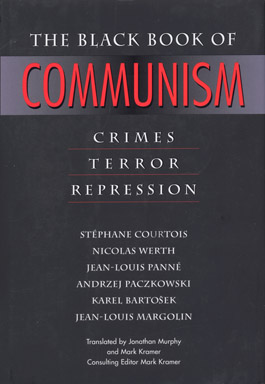
Already famous throughout Europe, this international bestseller plumbs recently opened archives in the former Soviet bloc to reveal the actual, practical accomplishments of Communism around the world: terror, torture, famine, mass deportations, and massacres. Astonishing in the sheer detail it amasses, the book is the first comprehensive attempt to catalogue and analyze the crimes of Communism over seventy years. "Revolutions, like trees, must be judged by their fruit," Ignazio Silone wrote, and this is the standard the authors apply to the Communist experience—in the China of "the Great Helmsman," Kim II Sung's Korea, Vietnam under "Uncle Ho" and Cuba under Castro, Ethiopia under Mengistu, Angola under Neto, and Afghanistan under Najibullah. The authors, all distinguished scholars based in Europe, document Communist crimes against humanity, but also crimes against national and universal culture, from Stalin's destruction of hundreds of churches in Moscow to Ceauşescu's leveling of the historic heart of Bucharest to the wide-scale devastation visited on Chinese culture by Mao's Red Guards. As the death toll mounts—as many as 25 million in the former Soviet Union, 65 million in China, 1.7 million in Cambodia, and on and on—the authors systematically show how and why, wherever the millenarian ideology of Communism was established, it quickly led to crime, terror, and repression. An extraordinary accounting, this book amply documents the unparalleled position and significance of Communism in the hierarchy of violence that is the history of the twentieth century. Stéphane Courtois is a director of research at the Centre National de la Recherche Scientifique (CNRS) in Paris and editor of the journal Communisme. Nicolas Werth is a researcher atthe Institut d'Histoire du Temps Present. Jean-Louis Panné collaborated on the Dictionnaire biographique du mouvement ouvrier français. Andrzej Paczkowski is Deputy Director and a professor at the Institute for Political Studies of the Polish Academy of Sciences. Karel Bartǒsek is a historian from the Czech republic and editor of the journal La nouvelle alternative. Jean-Louis Margolin is a lecturer in history at the University of Provence and a researcher at the Institut de Recherche sur le Sud-Est Asiatique of CNRS. |
|
"An 800-page compendium of the crimes of
Communist regimes worldwide, recorded and analyzed in ghastly detail
by a team of scholars. The facts and figures, some of them well
known, others newly confirmed in hitherto inaccessible archives, are
irrefutable. The myth of the well-intentioned founders—the good czar
Lenin betrayed by his evil heirs—has been laid to rest for good. No
one will any longer be able to claim ignorance or uncertainty about
the criminal nature of Communism, and those who had begun to forget
will be forced to remember anew." |
|
CONTENTS Foreword: The Uses of Atrocity Martin Malia Part I A State against Its People: Violence, Repression, and
Terror in the Soviet Union Part II Word Revolution, Civil War, and Terror Part III The Other Europe: Victim of Communism Part IV Communism in Asia: Between Reeducation and Massacre Part V The Third World Conclusion: Why? Stéphane Courtois |
|
EXCERPT (Introduction, page 17) How are we to assess Communism's crimes? What lessons are we to learn from them? Why has it been necessary to wait until the end of the twentieth century for this subject to show up on the academic radar screen? It is undoubtedly the case that the study of Stalinist and Communist terror, when compared to the study of Nazi crimes, has a great deal of catching-up to do (although such research is gaining popularity in Eastern Europe). One cannot help noticing the strong contrast between the study of Nazi and Communist crimes. The victors of 1945 legitimately made Nazi crimes—and especially the genocide of the Jews—the central focus of their condemnation of Nazism. A number of researchers around the world have been working on these issues for decades. Thousands of books and dozens of films—most notably Night and Fog, Shoah, Sophie's Choice, and Schindler's List—have been devoted to the subject. Raul Hilberg, to name but one example, has centered his major work upon a detailed description of the methods used to put Jews to death in the Third Reich. Yet scholars have neglected the crimes committed by the Communists. While names such as Himmler and Eichmann are recognized around the world as bywords for twentieth-century barbarism, the names of Feliks Dzerzhinsky, Genrikh Yagoda, and Nikolai Ezhov languish in obscurity. As for Lenin, Mao, Ho Chi Minh, and even Stalin, they have always enjoyed a surprising reverence. A French government agency, the National Lottery, was crazy enough to use Stalin and Mao in one of its advertising campaigns. Would anyone even dare to come up with the idea of featuring Hitler or Goebbels in commercials? The extraordinary attention paid to Hitler's crimes is entirely justified. It respects the wishes of the surviving witnesses, it satisfies the needs of researchers trying to understand these events, and it reflects the desire of moral and political authorities to strengthen democratic values. But the revelations concerning Communist crimes cause barely a stir. Why is there such an awkward silence from politicians? Why such a deafening silence from the academic world regarding the Communist catastrophe, which touched the lives of about one-third of humanity on four continents during a period spanning eighty years? Why is there such widespread reluctance to make such a crucial factor as crime—mass crime, systematic crime, and crime against humanity—a central factor in the analysis of Communism? Is this really something that is beyond human understanding? Or are we talking about a refusal to scrutinize the subject too closely for fear of learning the truth about it? |
|
|