     |
|
|
 |
|
'An excellent update on Romania after Ceauşescu, with enough
historical background, especially on the legacy of underdevelopment, to make
contemporary Romania comprehensible for a Western reader... his most original
contribution is the discussion on international assistance to Romania. Gallagher
criticises botl the IMF, for its contribution to the failure of Romania's
1997-2000 governments, and the EU for its lack of deeper understanding of what
Europeanization means for Romania.'
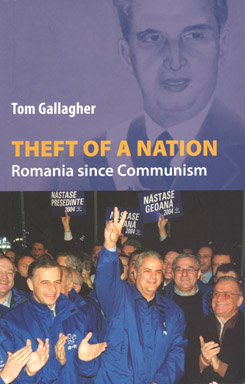
Having lynched the discredited Ceauşescu in 1989, former acolytes have spent the past fifteen years trying to retain a monopoly of control behind the faţade of a Western-style democracy. They combined their political ambitions with acquiring the control of vast amounts of private property denied to them by Ceauşescu. Political institutions were given a facelift, as in the case of the intelligence services which became a crucial power-base for the ruling Social Democratic Party (PSD). The state continued to be used to serve narrow private interests. Replacing the communist dynasty of the Ceauşescus, there is now an oligarchy drawn from the PSD and its satellites in the bureaucracy, major industries, and the intelligence world which grew wealthy through insider privatisation and the looting of the country's banks. Romania is now at a crucial turning-point. In 2004 the mobilisation of civil society contributed to the narrow victory of Traian Băsescu in presidential elections. It is unclear whether he can win control over the key levers of state necessary to stem the corruption and abuse of power which have blighted Romania's hopes of breaking free from its communist-era legacy. The PSD is now led by Mircea Geoana, the son of a general in Ceauşescu's Securitate. He has recruited a string of Western politicians to block pressure for meaningful change from Brussels and to ensure that accession to the EU occurs without serious reform. TOM GALLAGHER holds the Chair of Ethnic Conflict and Peace at Bradford University. He is the author of many books, most recently The Balkans After the Cold War: From Tyranny to Tragedy (2003) and The Balkans in the New Millennium: In the Shadow of War and Peace (2005). Cover photographs |
|
CONTENTS Acknowledgements 1. Democracy constrained by Backwardness, 1866—1945 2. Return to Underdevelopment: the Imposition and Consequences
of Communist Rule, 1945–1989 3. Comrades Discard the Ideology but Conserve the Power, 1990–1992 4. Romania Adrift, 1992–1996
6. A Broken-backed Coalition 7. Staggering to the Finishing Line 8. Taking Things to Extremes: the 2000 Elections and their
Outcome 9. A Messiah for Romania? Corneliu Vadim Tudor and the Greater
Romania Party 10. Looters of the State by Appointment of Brussels: Return of the Social Democrats, 2001–2003 11. Conclusion: the Crucial Role of the E.U. Notes |
|
|